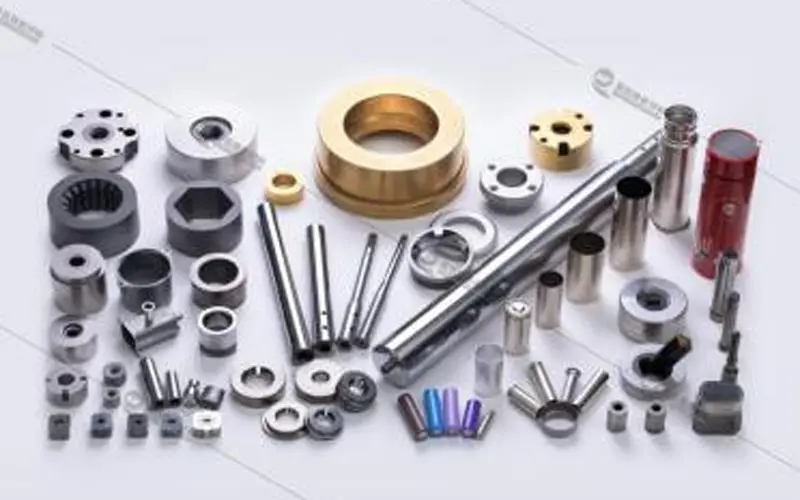
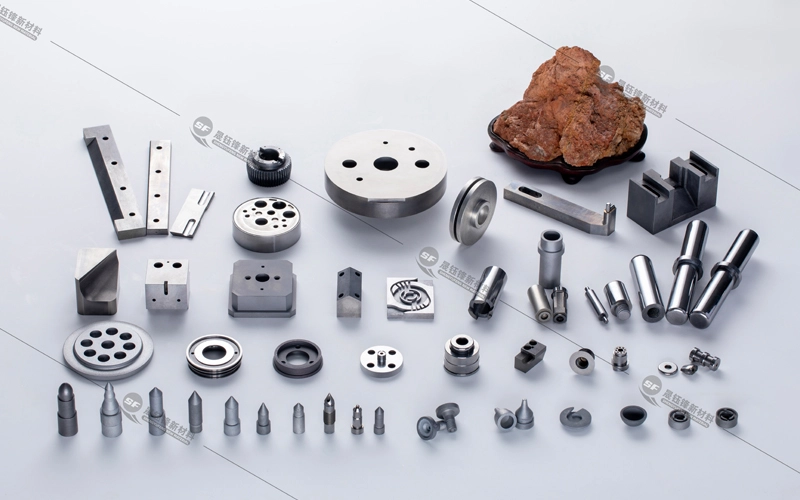
1. What is Cemented Carbide?
Cemented carbide is a type of cermet. Its composition includes a matrix of tungsten carbide powder and other metal carbides (such as WC, TiC, TaC, etc.) supplemented with one or more refractory metal powders (carbides, nitrides such as titanium carbide, tantalum carbide, niobium carbide, etc.) as the main components. Metal binder powders (cobalt, nickel, etc.) are added and the alloy is produced using powder metallurgy. It is widely used to manufacture high-speed cutting tools and cutting tools for hard and tough materials, as well as for making cold-work dies, measuring tools, and high wear-resistant parts that do not suffer impacts or vibrations.2. What are the characteristics of Cemented Carbide products?
(1) High hardness, wear resistance, and red hardness
Cemented carbide products can reach a hardness of 86-93HRA at room temperature, equivalent to 69-81HRC. They can maintain high hardness at 900-1000°C and have excellent wear resistance. Compared with high-speed tool steel, the cutting speed can be 4-7 times higher and the life can be 5-80 times longer, capable of cutting materials with a hardness of up to 50HRC. To meet different machining and industrial requirements, a variety of cemented carbide products are available with different grades, specifications, and performance characteristics.(2) High strength and modulus of elasticity
Cemented carbide products have a compressive strength of up to 6000MPa and a modulus of elasticity of (4-7)×10⁵MPa, both higher than those of high-speed steel. However, their flexural strength is relatively low, generally between 1000-3000MPa.(3) Good corrosion resistance and oxidation resistance
Cemented carbide products generally resist atmospheric, acid, and alkaline corrosion effectively and are not easily oxidized.(4) Low coefficient of linear expansion
Cemented carbide products maintain stable shape and dimensions during operation.(5) Finished products do not require further machining or regrinding
Due to their high hardness and brittleness, cemented carbide products are not subjected to further cutting or regrinding after powder metallurgy forming and sintering. Necessary reprocessing can only be done using electrical discharge machining, wire cutting, electrolytic grinding, or specialized grinding wheels. Products made to specific specifications from cemented carbide are usually used by brazing, bonding, or mechanical clamping onto the tool or die body.
3. Uses of Cemented Carbide products
(1) Cutting tools: Used for various cutting tools such as welded tools, CNC tools, solid carbide drills, and PCBs.
(2) Mining tools: Mainly used for impact rock drills, geological exploration drills, down-the-hole drills for mines and oilfields, roller cone drills, and shearer picks for coal mining, percussion drills for the building materials industry, and more.
(3) Molds: Wire drawing dies, cold heading dies, extrusion dies, stamping dies, drawing dies, and rolls. Cemented carbide used for various molds accounts for about 8% of the total cemented carbide production.
(4) Structural parts: Such as compressor pistons, lathe collets, grinder spindles, bearing journals, etc.
(5) Wear parts: Such as nozzles, guide rails, plungers, balls, tire studs, snowplow blades, and more.
(6) Chambers for high pressure and high temperature use: Such as hammer heads and pressing cylinders.
(7) Other uses: Such as watchchains, watch cases, zipper heads for high-end luggage, cemented carbide trademarks, etc.

 English
  English