CLOSE
CLOSE
Search
In powder metallurgy (PM), process stability is everything. Small variations in compaction pressure, die wear, or alignment can quickly turn into large variations in part density, dimensional accuracy, and final sintered performance. That’s why high-quality powder metallurgy dies are not just “tooling”—they are one of the most decisive factors in product quality, production efficiency, and cost control.
For manufacturers producing PM components at scale—whether for automotive, industrial, hardware, or specialty applications—choosing the right die material, geometry, and surface condition directly impacts output consistency and tool life. In this article, we’ll explain what powder metallurgy dies do, why tungsten carbide is widely used, and what to consider when sourcing custom PM dies for reliable mass production.
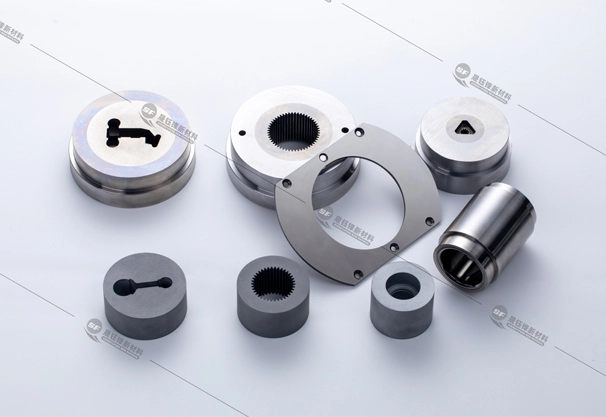
A powder metallurgy die is a precision toolset used to shape and compact metal (or ceramic) powders into a “green part” before sintering. During pressing, the die must withstand repeated high loads while maintaining tight tolerances and stable surface conditions. In real production environments, dies face continuous friction, abrasive powder contact, and cyclic stress—making wear resistance and dimensional stability essential. A typical PM tooling set may include a die core/cavity, punches (upper and lower), and related guiding and supporting components. The full system must work together to control powder flow, reduce density gradients, and deliver repeatable part geometry.
Compared with general tool steels, tungsten carbide tooling is often selected when manufacturers need higher wear resistance, better dimensional stability, and longer production runs between maintenance cycles. Key advantages of carbide PM dies include:
Excellent wear resistance: Powder pressing is highly abrasive. Carbide helps reduce cavity enlargement and edge rounding, improving dimensional repeatability over long runs.
High compressive strength: PM pressing requires strong resistance to compaction pressure and repeated loading cycles.
Stable precision: Carbide’s stiffness and wear properties support tighter tolerances and more consistent green part dimensions.
For many PM lines, better die performance translates into fewer tool changes, less downtime, and more stable sintered results—especially when output volume is high and consistency requirements are strict.
Powder metallurgy is widely adopted for near-net-shape parts and high-volume manufacturing. PM dies are commonly used to press components such as:
Structural PM parts requiring stable density control
Mechanical components where repeatable geometry reduces machining
High-volume pressed parts where tooling life affects total unit cost
Specialty compaction shapes requiring precise cavity design
Because PM production spans many part types, a “one-size-fits-all” die is rarely optimal. That’s why many buyers look for suppliers that can support custom powder metallurgy dies based on drawings, samples, or part performance targets.
When PM dies underperform, the symptoms typically show up as density variation, cracking, chipping, burrs, or dimensional drift. To prevent those issues, buyers should evaluate PM die solutions around the following factors.
In powder pressing, dimensional variation is often linked to cavity wear and tolerance drift. A well-engineered die focuses on:
Accurate cavity geometry
Controlled clearances between die and punch
Consistent alignment and guiding
Repeatable assembly interfaces
Tight tolerance control is not only about meeting a drawing on day one—it’s about staying within spec after thousands (or millions) of cycles.
Surface finish and contact behavior affect powder flow, ejection force, and wear rate. A stable surface condition helps:
Reduce sticking and improve ejection stability
Minimize abrasive wear
Improve green part surface consistency
In high-volume PM pressing, friction management often becomes one of the biggest contributors to tool life.
Carbide offers outstanding wear resistance, but tooling also needs a design approach that supports durability under cyclic loads. Optimizing geometry, edge treatment, and stress concentration points can reduce the risk of chipping or premature failure.
Consistent output requires more than good material. A reliable PM die supplier should be able to support:
Dimensional inspection for key functional features
Process control for repeatability between batches
Clear documentation of critical specifications
For PM manufacturers, consistent tooling quality reduces the need for frequent parameter corrections on the press—saving time and improving line stability.
If you want the most accurate die recommendation and pricing, prepare:
Part drawing (2D/3D) and key tolerances
Powder type and pressing condition (if available)
Target density or performance goals
Expected production volume
Any known pain points (wear location, sticking, cracking, etc.)
With these inputs, a tooling supplier can recommend suitable die material options, structure, and manufacturing approach, including solutions such as segmented dies for specific forming requirements, that better match your real production environment—rather than guessing based on generic assumptions.
For PM production, the cost of tooling is only part of the equation. What matters more is the total cost per part, which is heavily influenced by tool life, stability, and downtime. A specialized supplier of carbide PM dies can help you:
Extend tool life in abrasive powder environments
Improve consistency of green part dimensions
Reduce adjustments, scrap, and press downtime
Support custom designs for complex compaction needs
Scale from prototyping to stable bulk production
In powder metallurgy, the die is a direct lever for product consistency and manufacturing efficiency. High-quality powder metallurgy dies, especially carbide-based solutions, help manufacturers maintain tighter tolerances, reduce wear-driven variation, and achieve more stable compaction performance over long production cycles. If you are sourcing custom powder metallurgy dies for high-volume pressing or precision applications, choosing a supplier with strong carbide tooling capability and stable quality control can deliver measurable improvements in yield, uptime, and total production cost. Ready to optimize your powder pressing performance?
Send your drawing or specifications and request a quote for a custom powder metallurgy die solution.
Contact Us
 English
  English